


Investigation: Millions of Failed Voter Verifications Expose a Fractured System Dependent on SOS Reconciliation


By Randy Schiffer, MFEI News & Commentary Guest Investigator & Video
Platform Manager
January 7, 2025
Voter registration information from voting-age individuals without valid driver’s licenses fail to match Social Security Administration (SSA) data at a dramatic level.
Newly analyzed U.S. voter registration data from 2011 to 2025 reveal 28% (weighted average) of the 97 million new voter registrations from residents without valid driver’s licenses didn’t match SSA data.
“In Michigan, over the 14-year period, there were approximately 60,000 registrations that did not match with the SSA. It is up to the Secretary of State to investigate each non-match. It’s impossible to know whether that ever happens,” explained Patrice Johnson, founder and chair of Michigan Fair Elections Institute.
According to official federal government analysis of voter data submitted by 43 states and the District of Columbia, there is an astonishing number of failed voter data verifications as illustrated in Figure 1 below.

Figure 1. Total Non-Matches of Voter Verification Submissions from 2011-2025, USA.
Five states — Arizona, California, Illinois, New York, and Texas — had high numbers of erroneous voter verification submissions, all with over one million non-matches.
California wins the grand prize of worst non-match rate in the country. Out of a total of 9.5 million submissions, 6.9 million failed their verification checks — a failure rate of 73%.
The data illustrating the total number of submitted registrations and the associated percentage error rates of non-matches from 2011-2025 in 43 states plus the District of Columbia are illustrated in Table 1 below.
State | Number of Registrations Submitted (2011-2025) Without Valid DL | Number of Non-Matches with SSA Data | Percentage of Non-Matches | |
1 | Alabama | 1,641,132 | 250,350 | 15.25 |
2 | Alaska | 65,056 | 19,975 | 30.70 |
3 | Arizona | 6,940,229 | 2,099,734 | 30.26 |
4 | Arkansas | 3,067,769 | 594,908 | 19.38 |
5 | California | 9,527,233 | 6,934,421 | 72.80 |
6 | Colorado | 787,623 | 296,516 | 37.64 |
7 | Connecticut | 246,232 | 59,893 | 24.31 |
8 | Delaware | 4,856 | 705 | 14.51 |
9 | District of Columbia | 1,502 | 150 | 9.99 |
10 | Florida | 1,348,703 | 430,313 | 31.90 |
11 | Georgia | 2,031,253 | 873,576 | 43.01 |
12 | Hawaii | 24,167 | 3,505 | 14.50 |
13 | Idaho | 598,475 | 160,560 | 26.82 |
14 | Illinois | 9,144,008 | 1,481,377 | 16.20 |
15 | Indiana | 3,429,676 | 372,531 | 10.86 |
16 | Iowa | 431,286 | 113,073 | 26.22 |
17 | Kansas | 2,343,188 | 594,229 | 25.36 |
18 | Louisiana | 249,477 | 46,825 | 18.76 |
19 | Maine | 28,627 | 4,930 | 17.22 |
20 | Maryland | 850,854 | 596,331 | 70.09 |
21 | Massachusetts | 335,864 | 91,680 | 27.29 |
22 | Michigan | 192,928 | 60,371 | 31.30 |
23 | Minnesota | 866,442 | 109,041 | 12.58 |
24 | Mississippi | 33,868 | 7,378 | 21.79 |
25 | Missouri | 8,540,070 | 922,483 | 10.80 |
26 | Montana | 531,331 | 156,075 | 29.37 |
27 | Nebraska | 99,497 | 29,732 | 29.88 |
28 | Nevada | 1,075,402 | 757,521 | 70.43 |
29 | New Hampshire | 2,456 | 393 | 16.00 |
30 | New Jersey | 2,426,533 | 675,279 | 27.83 |
31 | New York | 3,668,507 | 1,674,796 | 45.66 |
32 | North Carolina | 2,179,121 | 641,649 | 29.44 |
33 | Ohio | 894,041 | 297,438 | 33.26 |
34 | Oklahoma | 21 | 10 | 47.62 |
35 | Oregon | 806,127 | 234,196 | 29.05 |
36 | Pennsylvania | 8,690,192 | 822,581 | 9.46 |
37 | Rhode Island | 614,578 | 54,003 | 8.79 |
38 | South Dakota | 180,115 | 31,856 | 17.68 |
39 | Texas | 26,989,831 | 7,080,485 | 26.25 |
40 | Utah | 300,100 | 89,243 | 29.74 |
41 | Vermont | 69,172 | 13,758 | 19.88 |
42 | Washington | 1,049,174 | 150,503 | 14.35 |
43 | Wisconsin | 308,452 | 43,379 | 14.07 |
44 | Wyoming | 658,232 | 170,527 | 25.91 |
Total | 103,273,400 | 29,048,279 | 28.13 |
Table 1. Help America Vote Verification (HAVV) Data from 2011-2025, USA[1]
The Help America Vote Act of 2002, P.L. 107-252 requires states to verify the information of newly registered voters in federal elections. In most cases, registrations are verified through the state’s Motor Vehicle Administration (MVA), but when a registrant doesn’t have a valid driver’s license, states submit the last four digits of the registrant’s Social Security number (SSN), name, and date of birth to the SSA for verification.
According to the SSA, a non-match occurs when the name, date of birth, and last four digits of a SSN submitted by a state election office cannot be matched with the SSA database. Many of these discrepancies can be a result of clerical errors or name changes.
In the key swing state of Michigan, approximately 192,000 verification checks were submitted and 31.3% (approximately 60,000) of these new voter registrations failed to match with SSA data.
Non-Matches from Deceased Voter Submissions
In the pool of registrants without valid driver’s licenses, a total of approximately 1.1 million deceased voters have been identified across all fifty states, as displayed in Figure 2 below.

Figure 2. Total Deceased Voters of Voter Verification Submissions from 2011-2025, USA.
Over 100,000 matches with deceased individuals were recorded in the states of Alabama, Arkansas, Kansas, Missouri, and Texas. These are new voter registrants who do not have valid driver’s licenses, and who, when run through the SSA, are found to be deceased. Some may have died between the time of completing the registration form and submission to the SSA, but what of the others? How was a deceased individual able to submit a new registration? It is unclear whether these 1.1 million voters, identified as deceased, were prevented from being added to the state voter registration rolls.
Figure 3 displays the total percentage of deceased voters identified in Michigan from the period of 2014 to 2025.

Michigan Department of State says since 2019, 419,990 deceased individuals have been removed from the voter rolls.
Why Faulty Registrations Result in SSA “Non-Matches”
Faulty or fabricated registrations are destined to fail SSA verification because the combination of name, date of birth, and last-four SSN digits will not correspond to any legitimate SSA record associated with a real citizen.
On a national scale, Figure 1 above illustrates the number of non-matches recorded across 44 states plus the District of Columbia over a 14-year period at approximately 29 million.
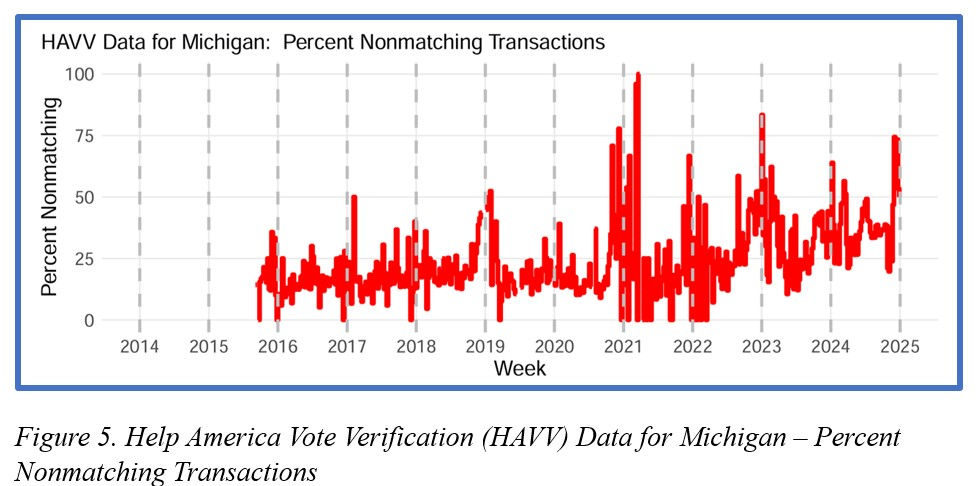
Figure 4 and Figure 5 below illustrate the total transactions and non-matches for the state of Michigan from 2014 to 2025. Notice the spikes in transactions in the months before large, national elections in late 2016, late 2020, and late 2024. The months leading up to elections generally coincide with heavy, third-party canvassing activity that registers voters in high volumes, so this is a possible explanation for these spikes.

How Many Non-Matches Can Be Explained by Rare, Legitimate Causes?
There are lawful reasons a U.S. citizen may not have a SSN, including being born abroad and never being issued a SSN, one’s parents declining to apply for one at birth, individuals raised in isolated or off-grid communities, elderly individuals born before widespread SSN issuance, or U.S. citizens who lived their entire lives outside the country. However, the number of these cases is likely low.
Are Third Party Voter Registration Organizations a Factor?
The number of non-matches among voter registrants without driver’s licenses is a cause of possible concern. When the numbers are so high across such a long period of time, critics wonder if the root cause is systemic and organized in nature, versus being attributed to individual mistakes on a case-by-case basis.
Case Study of Michigan
In Michigan, there is a long history of third-party voter registration activity. In 2004, the Michigan Senate formally recorded concerns regarding problems associated with voter-registration activity connected to outside groups. The Journal of the Senate for the 2003–2004 session includes statements noting that certain third-party voter-registration efforts had produced irregular or questionable registration activity, prompting warnings to election officials and calls for greater oversight of these operations.
Senator Alan Cropsey (R) mentioned voter registration drives by both parties:
There were huge drives on by both parties, by all parties, to make sure that everybody who might vote their way were registered to vote. Unfortunately, some people went out and collected what they said were voter registration signatures, but it turned out that they were fraudulent, PIRGIM being a key one in this process.
According to a 2005 Heritage Foundation report, the Public Interest Research Group in Michigan (PIRGIM) was a suspected third-party group that “submitted apparently-fraudulent applications.” There were reports of investigations associated with thousands of suspected fraudulent voter registrations across several Michigan counties being submitted to election officials. The Heritage report mentions that even the State Elections’ Director at the time, Christopher Thomas, said the “irregularities were like nothing he had seen before.”
This Senate journal publication reflected growing legislative concern at the time over the accuracy and reliability of registrations submitted by external organizations.
One of the most prominent cases of faulty voter registration submissions in Michigan emerged in October 2020, when Muskegon City Clerk Ann Meisch reported receiving between 6,000–10,000 voter-registration applications from a single organization.
Michigan State Police and the Attorney General’s office investigated and released a detailed police report showing the faulty registration forms originated from GBI Strategies, a Tennessee-based voter-registration firm contracted for multi-state campaigns.
Analysis revealed that GBI Strategies was funded with over $2.5 million for voter registration work in 2020 by a nonprofit organization known as the Voter Registration Project.
Estimates were that hundreds of these applications were suspected to be fraudulent based on invalid voter information such as forged signatures, wrong addresses, fictitious last four numbers of a SSN, and duplicate names. Michigan officials reported that none of these erroneous registrations were submitted or utilized to cast fraudulent votes and therefore the system “worked.”
Michigan’s Attorney General’s office noted that the misconduct appeared tied to low-level canvassers fabricating “work product” rather than a coordinated plot to cast fraudulent votes.
Conclusion
Nearly all fabricated, faulty, or falsified voter registrations are destined to fail federal identity checks. What exactly happens to voter registration records after they enter the federal identity-verification system and fail this process? Because their associated personal data does not match federal records, they are flagged by the SSA’s Help America Vote Verification (HAVV) system as non-matches. One can only hope such records are investigated and, when appropriate, deleted out of the state’s Qualified Voter File (QVF).
When the number of non-match voter registrations are this high, an investigation should be undertaken to identify the root cause. Once and for all, let’s settle whether these non-match voter registrations are associated with third party organizations canvassing for voter registrations rather than from individual voters themselves. Are the non-matches individualized or is there a systemic pattern?
As mentioned previously, legislative records show that concerns over “irregularities” linked to third-party voter-registration activities were formally noted in Michigan as far back as 2004. This illustrates a longstanding pattern of problems associated with external voter registration drives.
[1] This analysis draws on publicly available data from the Social Security Administration's (SSA) Help America Vote Verification (HAVV) program, accessible via the SSA Data Exchange website (ssa.gov/data/havv), which tracks voter registration submissions from voting-age individuals lacking a valid driver's license. Grok on XAI was used to access the government data and create the table. The dataset spans January 2011 through December 2025 and includes state-level aggregates of total submissions (registrations attempted without a driver's license for identity verification) and the subset of those that failed to match SSA records due to discrepancies in name, date of birth, or Social Security number. Non-match percentages were calculated for each state as the ratio of non-matching submissions to total submissions, multiplied by 100. States reporting zero submissions were excluded from tabulated views to focus on active jurisdictions, while aggregate metrics — such as the weighted average non-match rate (total non-matches divided by total submissions across all states, yielding 28.13%) — incorporate all available data for a national perspective. All computations were performed using standard arithmetic operations, ensuring transparency and reproducibility without adjustments for external factors like population size or registration policies.


All the data, all the organizations as far back as 2004 and still no final, formal cleaning Michigan voter rolls. Can't AI help here? Why isn't the Michigan Secretary of State in jail for her lying, her destroying of documents. Isn't the LAW to save all voter document for 22 months? Why is this corruption still going on? Why isn't Michigan demanding paper ballots only, voter ID ?