


Seth Keshel's Book Inspires with Facts and Humor
- Jun 9
- 3 min read
An election analyst's memoir with plenty of stats
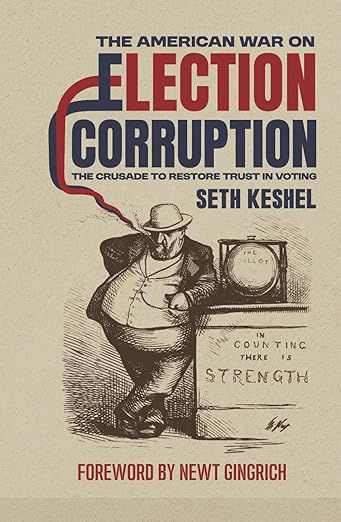
By Kristine Christlieb, MFEI News & Commentary Editor
June 9, 2026
Shamgar is a little-known Bible hero. He’s the guy in the book of Judges who gets only a one-verse mention but whose name is still invoked 3000 years later. The Bible account says he “struck down six hundred Philistines with an oxgoad.” It gives him further credit by saying, “He too saved Israel.”
Seth Keshel came to the fight for election integrity the same way Shamgar came to his — with whatever was at hand and no guarantee anyone would notice. In The American War on Election Corruption, Keshel recounts how he marshalled his Army captain analytical instincts, applied them to voting data, and created an unlikely weapon in the post-2020 election battle.
While Keshel is known for his analytic skill, The American War on Election Corruption isn’t a gray blur of spreadsheets and pie charts. Mostly, it is a personal account of Trump’s remarkable victory in 2016 and how one man became involved in the battle to “stop the steal.” For many of us in the movement, it brings back all those feelings from November 3, 2020.
Both Newt Gingrich’s foreword and Keshel’s introduction lay out what is at stake. Gingrich writes: “The fight for fair elections is the fight for the survival of the Republic.” Keshel echoes Gingrich saying:
If a constitutional republic is to survive in modern times, it will only do so when the citizenry trusts the most important processes. There is no more important process than elections.
The existential threat to the Republic is real. Anyone reading Keshel’s book will undoubtedly recall his or her own moment of truth, when protecting the trustworthiness of America’s elections became the clear priority requiring urgent, critical, and personal involvement.
Keshel reminds readers of the BBC’s assessment of telltale signs of election corruption from Africa. They are infuriatingly similar to what we saw in the 2020 election and even in more recent elections. Here’s the list from Keshel’s book:
· Mathematically impossible voter turnout
· High percentage of disqualified ballots
· Irrationally high turnout in some areas, which dwarf aggregates elsewhere
· Totals of votes that do not reconcile with number of issued ballots
· Results that don’t match polling station totals (in other words, made-up votes
· Delays in announcing results
It’s all coming back now . . . isn’t it?
The analytic skills Keshel used to predict Trump’s unlikely 2016 victory he turned on the 2020 election results. He created a fast-moving presentation he called “The Ten Irrefutable Points of the 2020 Election” and took it on the road. That slide deck was Keshel’s oxgoad. He crisscrossed the country presenting his findings to groups large and . . . ever larger, building a reputation in the growing election integrity community and gaining positive attention from President Trump and negative attention from corporate media outlets.
Through it all, Keshel has kept his head. He writes, “I valued accuracy over talking trash online and precision over being the guy to jump on a half-baked story before anyone else did.” Keshel’s discipline and personal integrity have served him well.
But another reason Keshel is beloved is because he is an Andrew Breitbart “happy warrior.” His most recent bit on the speaking circuit lays out the symptoms of “electile dysfunction.” Does your election last more than five days? It is hilarious.
Keshel is such an engaging speaker that anyone who has ever heard one of his presentations will want to read his book. They know it’s going to be fun and factual. I would not call The American War on Election Corruption fun. I would call it inspirational because it details how one man used the skills he had on behalf of his country when he believed it was in imperiled. As he writes, he took the podium as a veteran who had returned to service without a uniform.
Geeky readers will find plenty of numbers to satisfy their craving. But I think the book’s strength is one man’s personal story; it’s a reminder the tools available to any one person are rarely equal to the size of the problem.
Shamgar had an oxgoad; Keshel had a slide deck and a spreadsheet. Arthur Ashe put the principle plainly: "Start where you are. Use what you have. Do what you can." That's the book in a sentence — and the challenge it leaves behind.


Very good book. All verified data. An eye opener.