


ERIC blows through DOJ deadline; Benson keeps Michigan on ERIC’s roster

ERIC under fire for lack of transparency, bloated voter rolls, and sharing minor's personally identifiable information
by Patrice Johnson | Oct 21, 2026
On Sept. 30, the Justice Department demanded that the Electronic Registration Information Center (ERIC) open its books on its alleged sharing of drivers' personal data. Associate Attorney General Stanley E. Woodward Jr. gave the nonprofit until Oct. 7. The deadline came and went, and as of press time today, ERIC has not responded, according to sources familiar with the matter.

ERIC matches voter rolls against Michigan's motor vehicle records and 26 other member states, plus the District of Columbia. Woodward's letter cited the Driver's Privacy Protection Act (DPPA), which restricts disclosure of personal information from motor vehicle records. He asked for every recipient of ERIC's DMV data, every "research project" it has run, and its third-party correspondence back to Oct. 1, 2019. Woodward said he hoped ERIC would comply "rather than forcing the United States to take further action."
The Justice Department acted at the urging of Homeland Security Secretary Markwayne Mullin. On Sept. 2, he asked Attorney General Todd Blanche to investigate ERIC, as MFEI News & Commentary reported. In what was the department’s second request for action, Mullin wrote that ERIC exposes citizens’ private data “to unknown contractors, subcontractors and agents of ERIC.”
Two letters, one founder
A nearly identical letter went to the Center for Election Innovation & Research (CEIR). Both groups trace back to David Becker, who built ERIC while running the elections program at the Pew Charitable Trusts. Becker co-founded CEIR in 2016, and sat on ERIC's board as a non-voting member until March 2023.
Mullin alleged that ERIC shared motor vehicle data with CEIR before the 2020 election, a transfer ERIC officials defended under the DPPA's research exception (Colorado Politics). MFEI first reported the ERIC-CEIR pipeline in 2023.
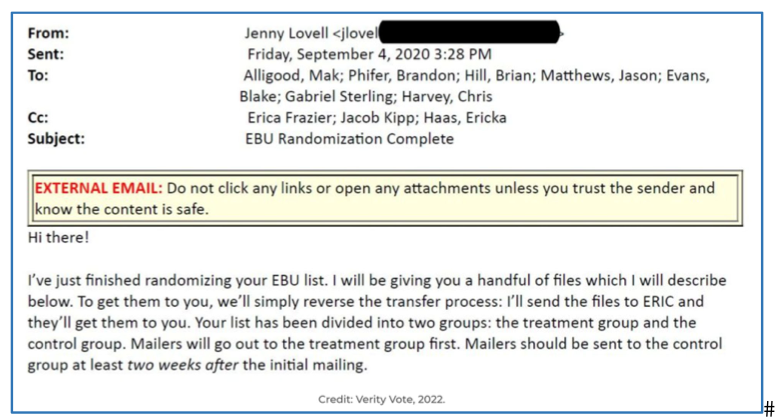
Source: Hayden Ludwig and Verity Vote, “The Best Data Money Can’t Buy.” Parts 1 and 2 are
available at https://restoration-news.com/eric-the-best-data-money-cant-buy-pt-1 and https://www.restorationofamerica.com/restoration-news/eric/eric-the-best-data-money-cant-buy-pt-2/
Becker has flatly denied that CEIR receives such data on an ongoing basis or uses it for partisan ends.
Michigan signs on
Jocelyn Benson was sworn in as secretary of state Jan. 1, 2019. Eight days later, she signed Michigan's ERIC membership agreement.

Michigan's signed agreement with ERIC. Agreeement obtained via MFEI Freedom of Information Act (FOIA)
In a post celebrating Michigan's arrival, Becker explained that ERIC works by "identifying citizens who aren't registered and requiring each state to contact those individuals about registering." In 2018, he had called ERIC "the single most effective voter registration drive in the history of the United States" (remarks).

Watch video: https://restoration-news.com/david-becker-eric-is-the-most-effective-voter-registration-drive-in-american-history
As of May 19, 2026, Michigan's voter file listed 8,331,635 registrants, or 108.9% of its 7,653,711 voting-age citizens (Vaeth/MFEI; U.S. Census CVAP; Michigan SOS dashboard). Federal law keeps inactive registrants on the rolls through two federal general elections, which explains part of the surplus. MFEI's submission to the EAC Inspector General identifies ERIC's outreach mandate as a contributing factor.
What Michigan signed
The agreement requires Michigan to send ERIC, at least every 60 days, "all inactive and active voter files" and "all licensing or identification records contained in the motor vehicles database." Listed fields include driver's license numbers, the last four digits of Social Security numbers, dates of birth, phone numbers and email addresses.
Because Michigan licenses drivers as young as 14 years, 9 months, those records include minors who have never registered. The agreement itself contains no hashing requirement.
Unnamed Contractors. The membership agreement expressly contemplates transmission of Michigan’s data to ERIC’s "agents, contractors or subcontractors." Section 4(a) neither identifies those recipients nor requires ERIC to disclose their identities.

Exhibit A, p. 15
ERIC's bylaws promise to protect personal data from disclosure "to anyone other than the members." Yet a 2021 email obtained through a records request shows ERIC's executive director confirming that "CEIR signed an NDA with ERIC" (MFEI).
Who covers whom. If Michigan improperly discloses ERIC data, Michigan "agrees to indemnify, defend and hold harmless ERIC," to the extent state law allows.

ERIC's board votes on whether Michigan stays.
According to unofficial minutes reviewed by MFEI, the board did exactly that in March 2022, after "Michigan's limited disclosure of federally protected data to a legislative committee." It voted unanimously to keep the state. ERIC's own promise to indemnify state motor vehicle agencies is "subject to consultation and approval by the Board."
The public is kept out. Before releasing ERIC data under a records request, Michigan must first obtain "a court order compelling it to do so." The Bureau of Elections cited the agreement in 2022 to deny a citizen's FOIA request.
Noncitizens are screened out of ERIC's view. The agreement bars states from sending any record "indicating that the individual is a non-citizen." That keeps known noncitizens off outreach lists. But it also means ERIC never sees the records that would flag noncitizens already registered. Meanwhile, Michigan must contact "each and every eligible or possibly eligible citizen" ERIC identifies, reaching at least 95% before the next federal election, or face automatic removal.

Exhibit A, p. 14
The roll-cleaning side. The agreement also requires states to contact voters whose records ERIC flags as "inaccurate or out-of-date." But it requires only contact. Nothing in it requires a state to remove anyone.
Defenders and critics
ERIC's defenders say it cleans voter rolls. Becker has credited ERIC with helping remove more than 200,000 dead voters, and ERIC says it hashes (scrambled) Social Security and license numbers, so they cannot be read.
Critics say the outreach reaches the wrong people. Mullin's letter said ERIC's 2022 list of unregistered Colorado residents included about 30,000 noncitizens.
MFEI and its affiliate, Pure Integrity Michigan Elections, have raised these concerns since 2022, from a federal HAVA complaintto a 30-page ERIC section in MFEI's 2026 report. For an overview, see MFEI's ERIC fact sheet.
The money
ERIC is not Becker's only Michigan connection. In September 2020, CEIR gave $12.04 million to the Michigan Center for Election Law and Administration, a nonprofit Benson founded in 2008, as MFEI has reported.
What comes next
The Justice Department has not said what it will do. An administration official told reporters the options include a cease-and-desist order, legal penalties, or a look at ERIC's 501(c)(3) status.
Michigan remains an ERIC member. Benson remains in charge of its elections. She is also the Democratic nominee for governor, overseeing a Nov. 3 election with her own name on the ballot.
The clock ran out on ERIC Oct. 7. Now, Michigan voters await answers.
Kristine Christlieb contributed to this article.
Author Patrice Johnson is Chair and Co-Founder of the Michigan Fair Elections Institute (501(c)(3)) and Pure Integrity Michigan Elections (501(c)(4)). She is a founder of five technology companies, former Fortune 50 executive, and the award-winning author of The Fall and Rise of Tyler Johnson, a book that became the basis of the PBS documentary film, Finding Tyler.


Comments