


We Told You So: Long Before DHS Sounded the ERIC Alarm, Michigan Fair Elections Already Had

By Kristine Christlieb, MFEI News & Commentary Editor
September 9, 2026
In its role as protector of critical infrastructure, the Department of Homeland Security (DHS) is asking the Department of Justice (DOJ) to investigate whether a non-profit organization illegally passed Americans' private driver's-license data to outside political groups.
In a letter dated September 2, DHS Secretary Markwayne Mullin reminded U.S. Attorney General Todd Blance that this was the second time his department had pointed out dangers to election systems. Mullin wrote:
DHS identified several issues during my predecessor's [Kristi Noem] tenure that resulted in referrals to the Department of Justice. Due to the potential impact of the issues identified, I want to make sure that you are aware of these prior referrals.
The delay, while frustrating, may not be bureaucratic inertia. At least one of the identified issues — the one related to the non-profit's handling of driver's license data (and this is the one most relevant to Michigan) — DOJ may simply be unable to prove what the law requires it to prove.
Here's the situation: Michigan and many other states contracted with a nonprofit organization called Electronic Registration Information Center (ERIC) to keep voter rolls accurate, tracking deaths and voters' moving.
But according to Mullin's letter, "ERIC exposes millions of citizens' sensitive, private data [including social security and driver's license numbers] to unknown contractors, subcontractors and agents of ERIC — potentially in violation of the Driver's Privacy Protection Act [DPPA]."
Mullin also claims that prior to the 2020 election, one of the organizations to which ERIC turned over private information was the Center for Election Innovation and Research (CEIR).
CEIR describes itself as doing research and grantmaking to support election administration. In practice, that's included distributing roughly $70 million from Mark Zuckerberg's foundation to election offices in 2020, and funding research on whether states efforts to reach eligible but unregistered voters has actually worked.
In January 2019, her first week in office, Michigan Secretary of State Jocelyn Benson signed up for ERIC. In 2020, CEIR gave $12M to the Michigan Center for Election Law and Administration (MCELA), the nonprofit Benson herself founded in 2008. She led MCELA for roughly a decade but stepped down as president right before the $12 million grant arrived in September 2020. Of that $12 million, $11.8 million was reportedly passed along to two Democrat-leaning political consulting firms — Waterfront Strategies and Alper Strategies.
Michigan Fair Elections Institute Ahead of the Curve
None of this is news to followers of Michigan Fair Elections Institute (MFEI). While Michigan is not named in Mullin's letter to the DOJ, Michigan Fair Elections Institute has been asking the hard questions about ERIC since 2022.
Patrice Johnson, Chair and Founder of Michigan Fair Elections Institute summarized the Secretary of State's actions:
"Benson claimed ERIC would clean the voter rolls, but that was a smoke screen for what ERIC really does. Thanks to ERIC we now have more registered voters than voting aged residents, and ERIC rejects notifications about noncitizens. The contract Benson signed allows ERIC to share voters' — even minors' — private, personal information with undisclosed agents."
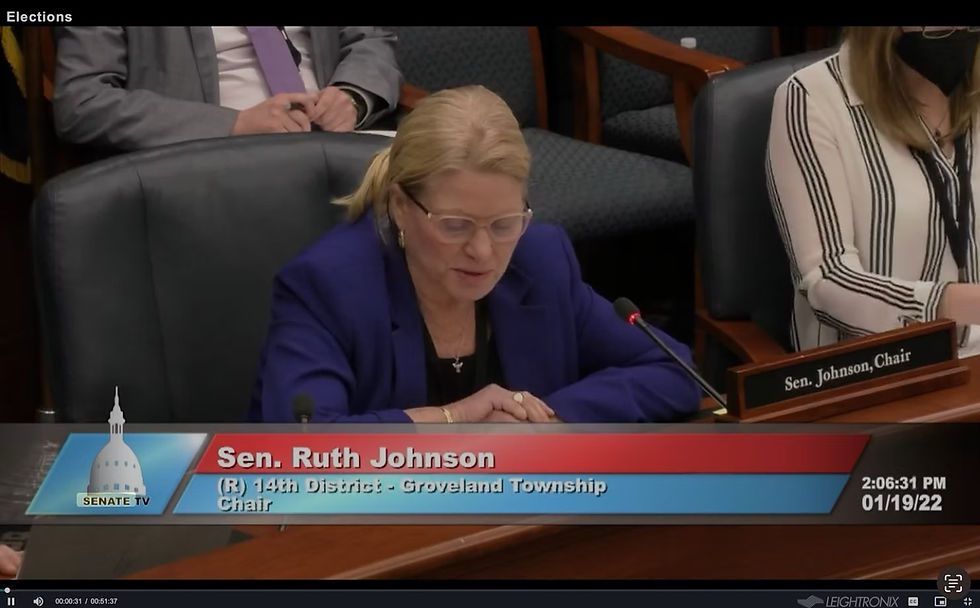
During a hearing in January 2022, Michigan State Senator Ruth Johnson, then chair of the state's Senate Elections and Ethics Committee, asked Adam Reames, the policy director for Secretary of State Jocelyn Benson, “I'd like to know what you have now as processes to ensure non-citizens are not registered to vote when they’re processing other transactions in a branch or whenever they are there for like a vehicle registration.”
Later that year, in August, MFEI published Verity Vote's documentation showing ERIC was sharing personally identifying information on unregistered residents with CEIR. State Rep. Ann Bollin, then chair of Michigan's House Elections and Ethics Committee, told MFEI in 2022 she had "initiated a deeper dive" with legal counsel toward a possible oversight hearing.
Again, in 2023, MFEI was warning ERIC was slipping non-citizens onto the voter rolls. Since 2022, MFEI has published literally dozens of articles sounding the alarm about ERIC. That work culminated last month, in the publication of a 720-page report, Michigan Election Issues 2020 & Ripple Effects that included a 30-page section entitled "ERIC Violations, DPPA Breaches, and Privatization of Voter Roll Infrastructure." It details how ERIC has endangered Michigan's and other states' voter rolls administered under contract with the nonprofit.
Now What?
It's easy to read a year of DOJ silence as capitulation. It may instead be a case of DOJ concluding it doesn't have a provable case, which means the conduct can continue exactly as before, indefinitely, so long as everyone involved keeps a careful enough paper trail. Keep in mind, the case depends on DOJ being able to prove ERIC knowingly shared driver information with CEIR.
But if DOJ needs some back-up, it would do well to turn to Michigan Fair Elections Institute for a state-specific record of how ERIC and CEIR have been using and sharing driver's license data to influence elections.




Does it really matter? Regardless of what crimes the investigations uncover...nobody will be prosecuted. Again.
Please hold a public oversight hearing and request an independent audit tracing all Michigan motor-vehicle and eligible-but-unregistered data provided to ERIC, CEIR, and their contractors. Please disclose the applicable agreements, data fields, recipients, permitted uses and security controls, and suspend any transfers that cannot be shown to comply with the Driver’s Privacy Protection Act.